Wednesday, June 19, 2013

Adolph Spicker


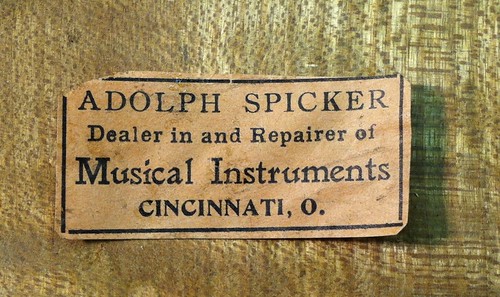
Pulled the top off a violin today, and found this little repair label glued to the rib near the end-block.  It's about 3/4" by 3/8", and came loose from the rib, being photographed here against the inside back.  After getting my work done, I glued it back in place.

It reads: ADOLPH SPICKER, Dealer in and Repairer of Musical Instruments, Cincinnati, O.

I hadn't heard of Adolph Spicker, but did a quick internet search.  I found this news story from March 17, 1928.

ADOLPH SPICKER DIES
  Friends of Adolph Spicker, aged 60, of Cincinnati, Ohio, last week were shocked to hear of his death, which occurred at his home on Friday.  He was proprietor of a violin store and repair shop in Cincinnati and numbered among his clients Ysaye, Kriesler, and MacMillen.  He received his musical education in Germany.


Friday, May 24, 2013

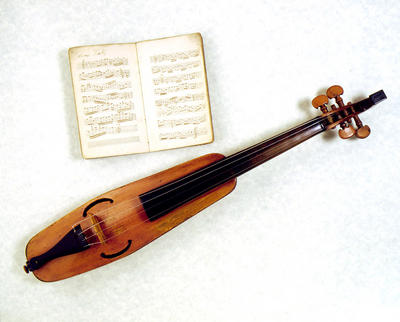
Glasgow Kit Fiddle

For some time, I've wanted to build a kit fiddle, aka pochette or dance master's fiddle.  Just never got around to it.  A kit fiddle, as I understood it, was primarily used by dance masters as they gave instruction in the homes of the well-off.  This was the way people learned the dances, in order to show proper education at those formal public events. The National Music Museum has a nice photo display of pochettes, including this of one in action.


These things are tiny, say 15 inches or so, and not meant to put out much volume -- a tool for a job, one that isn't done much these days.

Last month, Rachel Barton Pine put on a concert of Vivaldi's Four Seasons with the Boise Baroque Orchestra.  In conjunction with that, she gave a talk on Baroque performance techniques, which I also attended.  During the talk she made two points regarding kit fiddles that caught my ear.  First, these were also used as traveling fiddles.  Most taverns had a violin for use by customers, and since it was hard enough to travel in those days, it would be an additional chore to carry along a full-size instrument.  But travelers might want to play a few tunes, so these pochettes, with their small bows and small cases, could be taken along to while away the idle time.

This also struck me, having just returned from a trip where I took my full-sized fiddle, case, and bow, and then ended up putting a heavy practice mute on it to while away the random spare time in the motel room, learning a few new tunes with my iPhone headphones on.  I'm traveling to see things, and the violin is nice to have along, but I'm not performing.  Something smaller to carry, particularly when flying, would be convenient.

The second thing Mrs Pine mentioned that caught my ear was that while idling away the hours, these travelers developed, or improved, their strathspey bowing.  I'm still not sure how, but since I am involved with Scottish Country Dance, that was interesting to me.

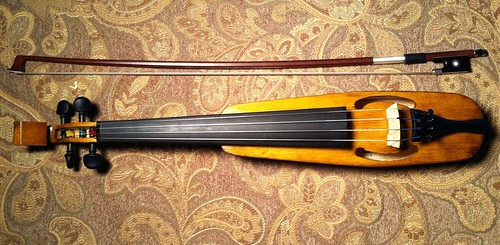
So, I started looking through my collected materials and that on the web.  I wanted a simple design, as this was a concept to be tried, and I didn't want to get bogged down in decorative details.  I settlled on the Glasgow Kit Fiddle --


I had no dimensions for this instrument, but decided to go with a 3/4 violin string length and scale from that to the size of the photo.  I drew out a pattern and cut a simple plywood form.


I should add that since I was being simple, I decided also to be cheap.  All the material I used, except the fingerboard and the ribs, were scrap I had lying about the shop -- discarded other projects.

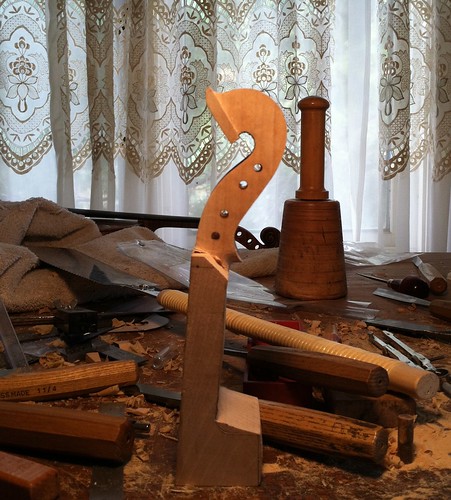
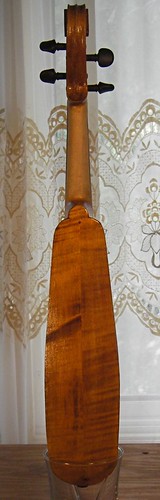
The neck I cut from a block of local maple, roughly at the right orientation.


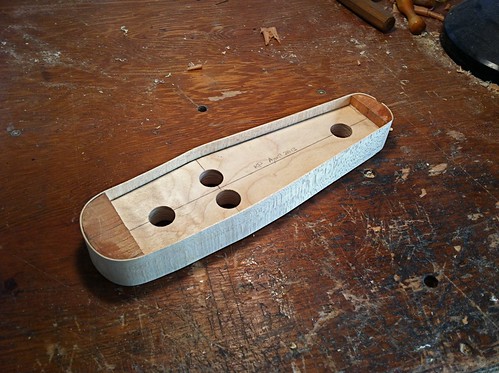
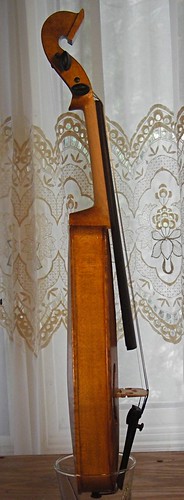
The ribs I bent in one piece.  Not sure that was a great idea, but that's what I did this time.


When I was done, I had a kit fiddle with a total length of just under 20 inches.  Here it is next to a 1/4-size violin bow.


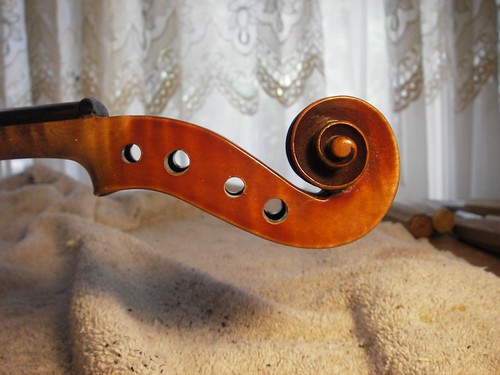
Still learning how to play the thing, and plan to put up a video soon.  If you'd like to see more details of the construction, you can go to my Flickr set (assuming the new format allows such a thing).

Thursday, May 23, 2013

Peg-box crack

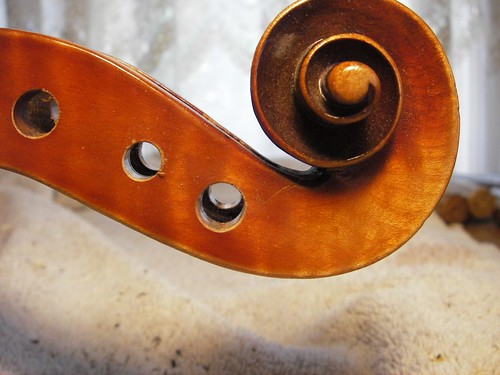
Here's a view of the treble side of a more-or-less typical early-20th-century factory fiddle.


When looking at a used/vintage fiddle with the idea of purchase, this is a good area to examine closely.


Note the little bent "line" near the far-right peg hole.  Look closer.


This is a crack, and it's a crack that would put me off purchasing the instrument unless there were some other highly attractive parts that would make the cost of repair worth it.  This type of crack needs serious repair, not just a simple glueing.

It's probably the most common location for a peg-box crack, on the A-peg of a violin (or the D-peg of a viola or cello), because often the grain runs out towards the carved edge.  This one is a bit unusual, in that the grain is twisty here and the crack follows that twisty grain.  Often, it is a straight crack, following the straight-grain of the pegbox.

I'll have to talk to the customer to see what they want to do with this.  It can be repaired.  Simply a matter of worth and value, which needs some thought.

Thursday, May 2, 2013

Lutherie Tip of the Day


When drilling string-holes in pegs, the pegbox makes an excellent holder.
Follow-through with the drill bit is crucial!


Clarity for the humor-impaired: this is not a good idea.
And is not something I would do (I hope!).

The instrument came into the shop with this previously
done work.

Thursday, March 7, 2013

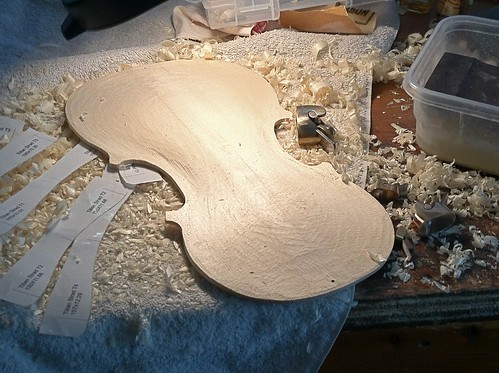
Top arching.


Just an in-progress shot, complete with messy bench; I'm waiting for a customer to show up with a bass that's lost its neck and another with a couple fiddles that need some tending-to.

The top is at the point I really need to finish the outline, get the corners into shape, and get the purfling installed.  This spruce is really chippy, so I have the wet-stone at the ready for sharpening touch-ups.  I'm using an Bros. Amati outline and Strad "Titian" arching.

Tuesday, March 5, 2013

Idaho at 150.

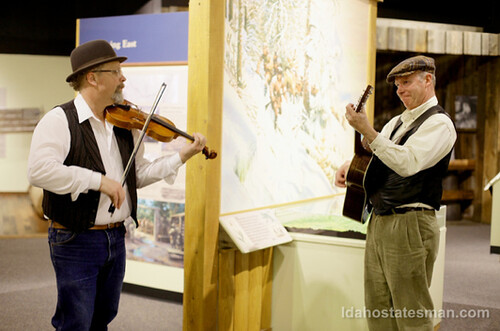
150 years ago yesterday, President Lincoln signed into being the Idaho Territory.  The Idaho Historical Museum put together an exhibit in honor of this, "150 Things that Make the Gem State Unique."  Tim and I were asked to wander about during the Friends of the Museum opening last night, playing a few tunes.  We're always delighted to play at the Museum -- a favorite spot.

Just playing whatever came into our heads, we did manage to get into the Boise paper, the Idaho Statesman --


One of the local TV stations caught us, too.  We're only on film for a brief moment, though our music keeps going.  I'm unaccoustomed to having a TV camera filming me while I play, and spent some energy trying not to make too many weird faces.  Had I known it would be used for background music, I would have relaxed a bit!  :-)  Here's a link to the piece.

The fiddle here is the one I described building in posts throughout last summer and fall.

Friday, February 8, 2013

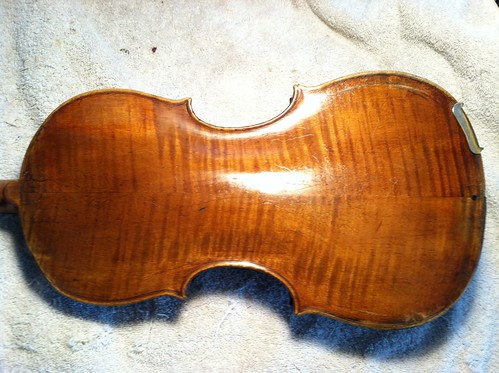
labeled Klotz 1760-ish.

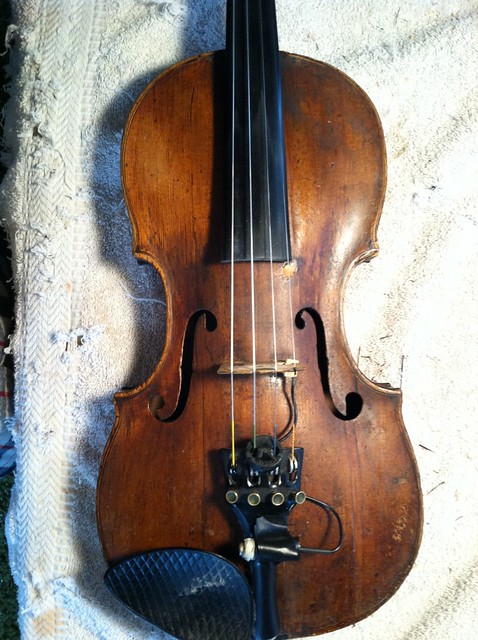
This one is owned by a retired fellow, who has had it for some time.  I don't know if it is what it reports to be, Egidius Klotz 1760 (or so), but it could be.  Glued a seam, new strings, and replaced the old electronic pick-up with a newer model.  He plays it daily.


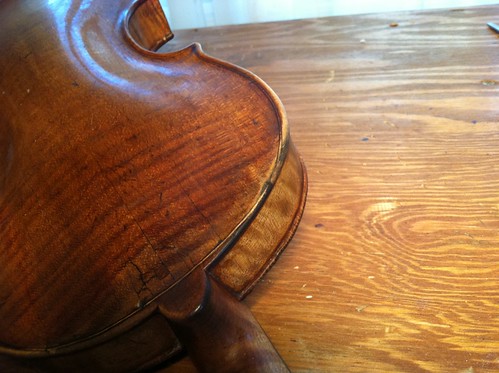
The back has a pleasant flame and shows lots of wear, including relatively recent damage such as shoulder rest abrasions, which are also present on the ribs.


The upper treble bout is so worn that wood is even missing through the purfling itself. Evidence of lots of playing time. The button looks as if it may have been broken, or badly crakced at the least.


Both f-holes are missing wings. This one has had a repair, possibly to correct for soundpost-tool damage. Dunno.


The label is very hard to read.  It seems to follow the pattern: Egidius Klotz in Mittenwald and der Isar 1760.  Could be 1762.  Or 1768.  Or something else. 


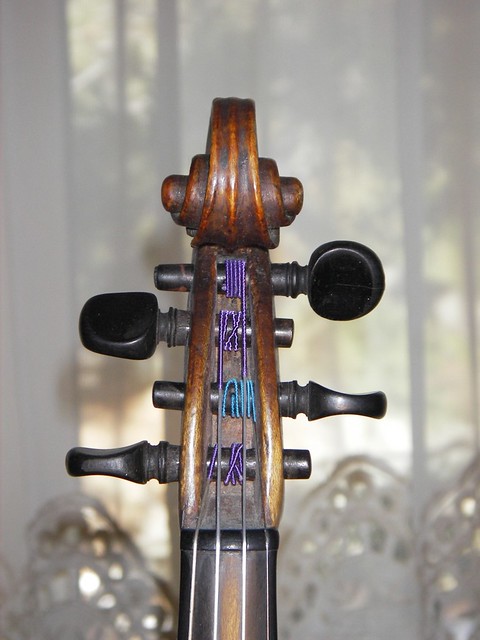
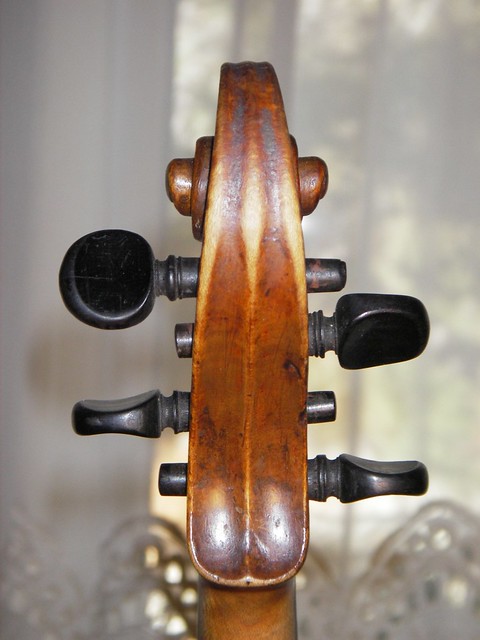
Front of the scroll, showing what I think is a very nice patina.


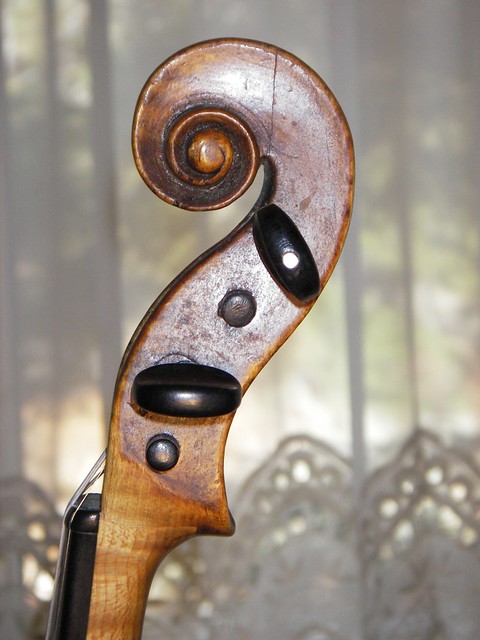
Apparently the volute became separated from the pegbox at some time.  The pegbox and scroll have been grafted onto a new neck.


Back of the scroll with a rather square bottom.  Perhaps a compass layout mark where the spine meets the bottom curve.