Friday, May 24, 2013

Glasgow Kit Fiddle

For some time, I've wanted to build a kit fiddle, aka pochette or dance master's fiddle.  Just never got around to it.  A kit fiddle, as I understood it, was primarily used by dance masters as they gave instruction in the homes of the well-off.  This was the way people learned the dances, in order to show proper education at those formal public events. The National Music Museum has a nice photo display of pochettes, including this of one in action.


These things are tiny, say 15 inches or so, and not meant to put out much volume -- a tool for a job, one that isn't done much these days.

Last month, Rachel Barton Pine put on a concert of Vivaldi's Four Seasons with the Boise Baroque Orchestra.  In conjunction with that, she gave a talk on Baroque performance techniques, which I also attended.  During the talk she made two points regarding kit fiddles that caught my ear.  First, these were also used as traveling fiddles.  Most taverns had a violin for use by customers, and since it was hard enough to travel in those days, it would be an additional chore to carry along a full-size instrument.  But travelers might want to play a few tunes, so these pochettes, with their small bows and small cases, could be taken along to while away the idle time.

This also struck me, having just returned from a trip where I took my full-sized fiddle, case, and bow, and then ended up putting a heavy practice mute on it to while away the random spare time in the motel room, learning a few new tunes with my iPhone headphones on.  I'm traveling to see things, and the violin is nice to have along, but I'm not performing.  Something smaller to carry, particularly when flying, would be convenient.

The second thing Mrs Pine mentioned that caught my ear was that while idling away the hours, these travelers developed, or improved, their strathspey bowing.  I'm still not sure how, but since I am involved with Scottish Country Dance, that was interesting to me.

So, I started looking through my collected materials and that on the web.  I wanted a simple design, as this was a concept to be tried, and I didn't want to get bogged down in decorative details.  I settlled on the Glasgow Kit Fiddle --
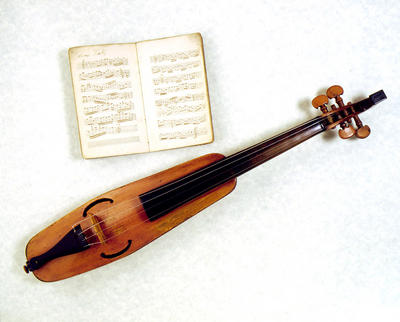

I had no dimensions for this instrument, but decided to go with a 3/4 violin string length and scale from that to the size of the photo.  I drew out a pattern and cut a simple plywood form.


I should add that since I was being simple, I decided also to be cheap.  All the material I used, except the fingerboard and the ribs, were scrap I had lying about the shop -- discarded other projects.

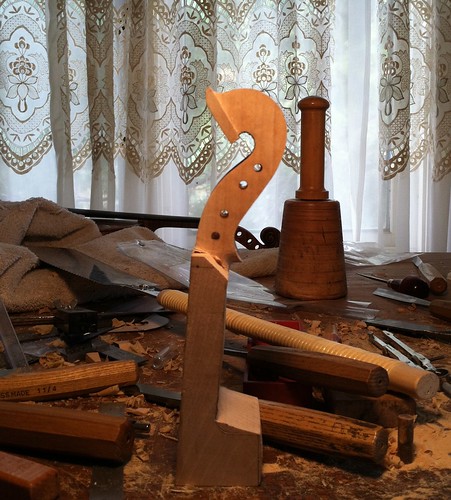
The neck I cut from a block of local maple, roughly at the right orientation.


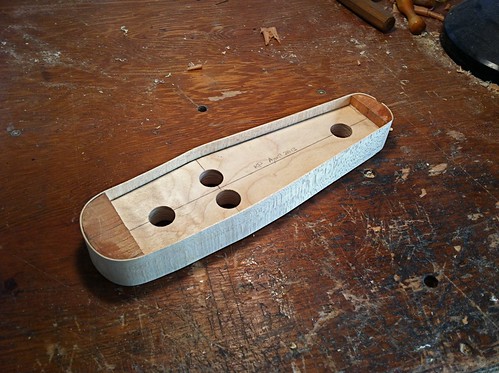
The ribs I bent in one piece.  Not sure that was a great idea, but that's what I did this time.

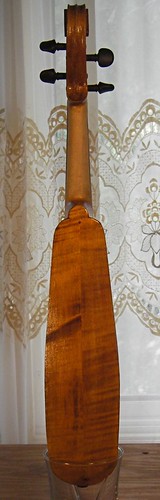
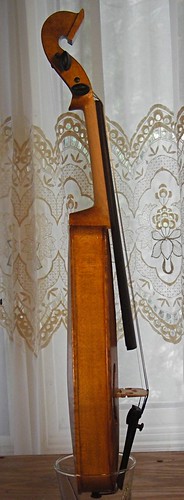
When I was done, I had a kit fiddle with a total length of just under 20 inches.  Here it is next to a 1/4-size violin bow.
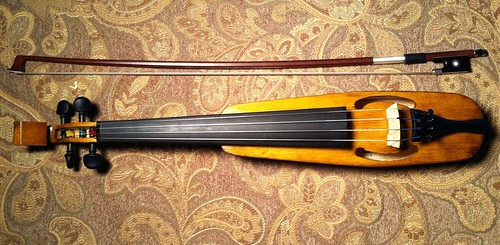


Still learning how to play the thing, and plan to put up a video soon.  If you'd like to see more details of the construction, you can go to my Flickr set (assuming the new format allows such a thing).

Thursday, May 23, 2013

Peg-box crack

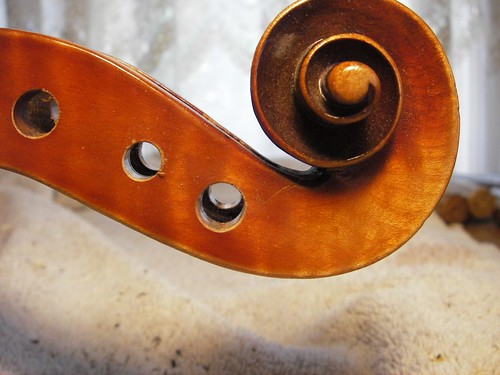
Here's a view of the treble side of a more-or-less typical early-20th-century factory fiddle.


When looking at a used/vintage fiddle with the idea of purchase, this is a good area to examine closely.


Note the little bent "line" near the far-right peg hole.  Look closer.


This is a crack, and it's a crack that would put me off purchasing the instrument unless there were some other highly attractive parts that would make the cost of repair worth it.  This type of crack needs serious repair, not just a simple glueing.

It's probably the most common location for a peg-box crack, on the A-peg of a violin (or the D-peg of a viola or cello), because often the grain runs out towards the carved edge.  This one is a bit unusual, in that the grain is twisty here and the crack follows that twisty grain.  Often, it is a straight crack, following the straight-grain of the pegbox.

I'll have to talk to the customer to see what they want to do with this.  It can be repaired.  Simply a matter of worth and value, which needs some thought.

Thursday, May 2, 2013

Lutherie Tip of the Day


When drilling string-holes in pegs, the pegbox makes an excellent holder.
Follow-through with the drill bit is crucial!


Clarity for the humor-impaired: this is not a good idea.
And is not something I would do (I hope!).

The instrument came into the shop with this previously
done work.

Thursday, March 7, 2013

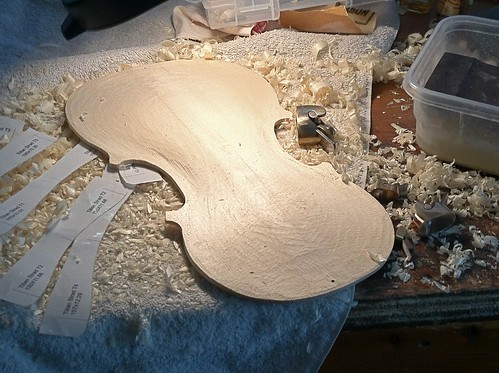
Top arching.


Just an in-progress shot, complete with messy bench; I'm waiting for a customer to show up with a bass that's lost its neck and another with a couple fiddles that need some tending-to.

The top is at the point I really need to finish the outline, get the corners into shape, and get the purfling installed.  This spruce is really chippy, so I have the wet-stone at the ready for sharpening touch-ups.  I'm using an Bros. Amati outline and Strad "Titian" arching.

Tuesday, March 5, 2013

Idaho at 150.

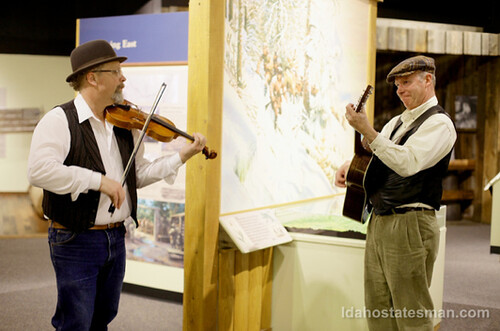
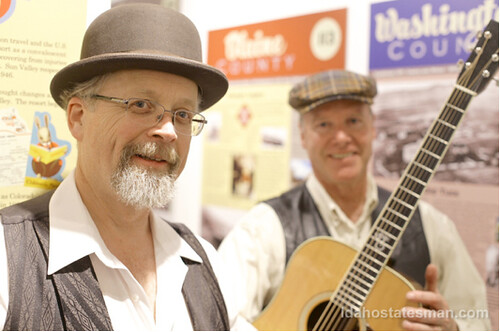
150 years ago yesterday, President Lincoln signed into being the Idaho Territory.  The Idaho Historical Museum put together an exhibit in honor of this, "150 Things that Make the Gem State Unique."  Tim and I were asked to wander about during the Friends of the Museum opening last night, playing a few tunes.  We're always delighted to play at the Museum -- a favorite spot.

Just playing whatever came into our heads, we did manage to get into the Boise paper, the Idaho Statesman --


One of the local TV stations caught us, too.  We're only on film for a brief moment, though our music keeps going.  I'm unaccoustomed to having a TV camera filming me while I play, and spent some energy trying not to make too many weird faces.  Had I known it would be used for background music, I would have relaxed a bit!  :-)  Here's a link to the piece.

The fiddle here is the one I described building in posts throughout last summer and fall.

Friday, February 8, 2013

labeled Klotz 1760-ish.

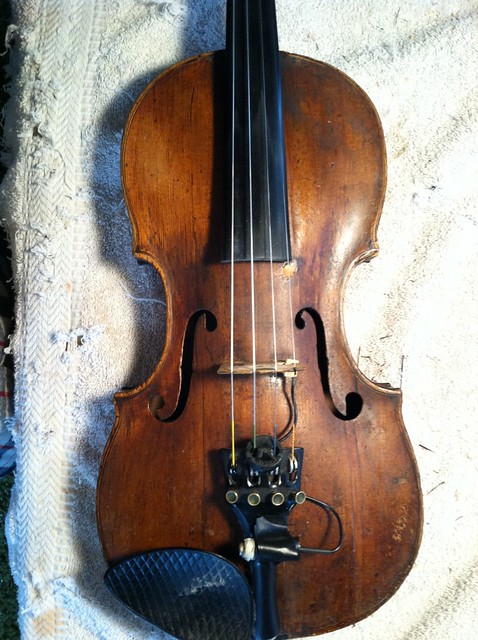
This one is owned by a retired fellow, who has had it for some time.  I don't know if it is what it reports to be, Egidius Klotz 1760 (or so), but it could be.  Glued a seam, new strings, and replaced the old electronic pick-up with a newer model.  He plays it daily.


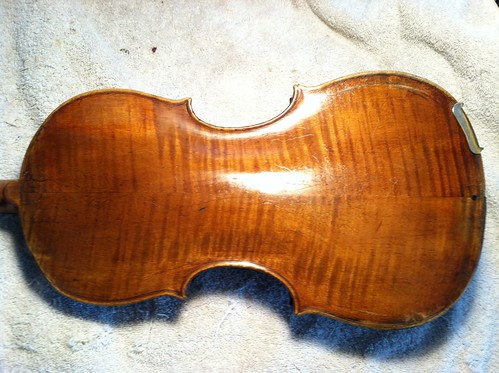
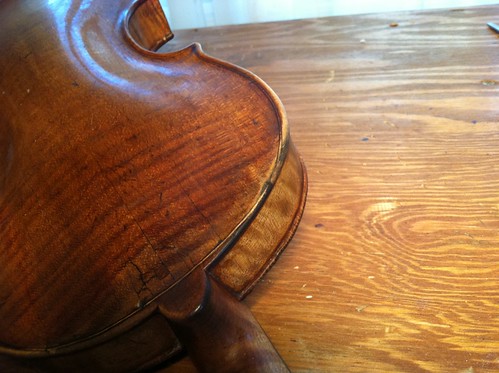
The back has a pleasant flame and shows lots of wear, including relatively recent damage such as shoulder rest abrasions, which are also present on the ribs.


The upper treble bout is so worn that wood is even missing through the purfling itself. Evidence of lots of playing time. The button looks as if it may have been broken, or badly crakced at the least.


Both f-holes are missing wings. This one has had a repair, possibly to correct for soundpost-tool damage. Dunno.


The label is very hard to read.  It seems to follow the pattern: Egidius Klotz in Mittenwald and der Isar 1760.  Could be 1762.  Or 1768.  Or something else. 


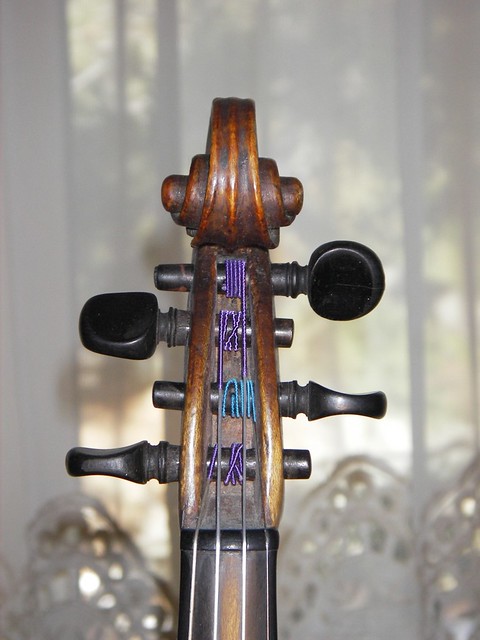
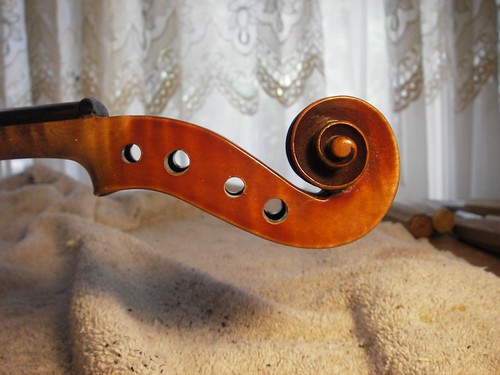
Front of the scroll, showing what I think is a very nice patina.


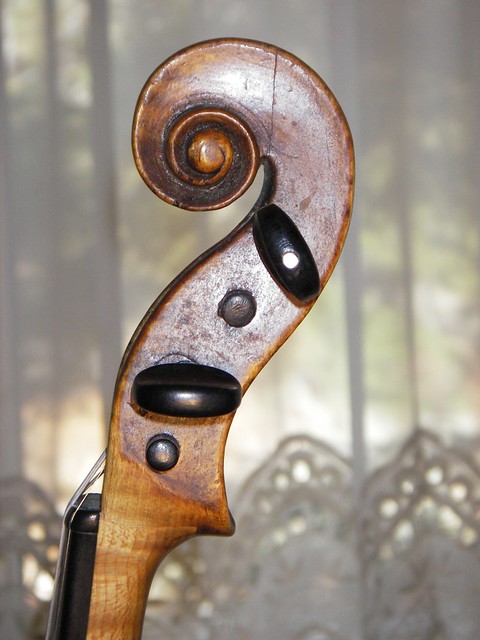
Apparently the volute became separated from the pegbox at some time.  The pegbox and scroll have been grafted onto a new neck.


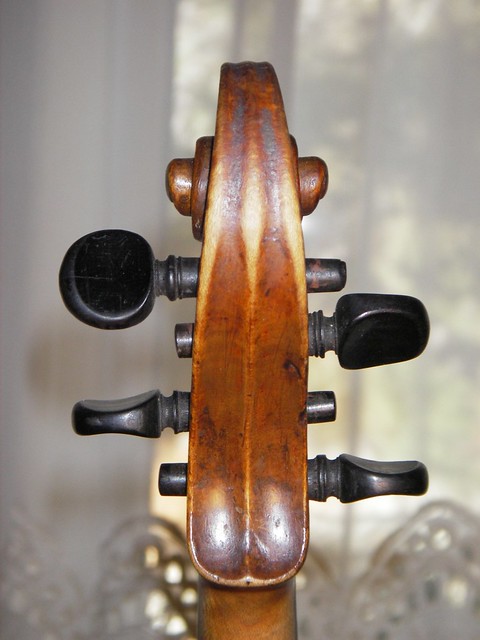
Back of the scroll with a rather square bottom.  Perhaps a compass layout mark where the spine meets the bottom curve.


Tuesday, February 5, 2013

Secrets of the Samurai Sword (PBS)

I recently posted a link (on my Facebook page) to a 4-minute video on Samurai swords, the Sword Maker.  One of my FB violin-maker friends, Jack Havivi of Tel Aviv, gave me the link to a PBS hour-long documentary, now on YouTube, for Secrets of the Samurai Sword.  Both are worth seeing, and naturally the longer PBS version has far more detail.

At one point in the documentary, they refer to "Sword Porn" being the term for the movies most of us in the West have as a basis for knowing anything about the Samurai.

I guess I could diverge and say that many of us seem to get most of our 'knowledge' from movies, but that might be considered cynical, so I won't.

Anyway, in addition to enjoying sword porn, this PBS documentary is also, for us woodworkers, carbon-steel, sharp-edge, traditional-arts, marketing, blacksmith-alchemy, random-effects, waterstone porn.  For me, it hit all of those buttons.

The traditional art of steel-making is also explained in scientific terms, this being PBS, but in doing so, they actually show reverence for the randomness and skill in the process, skill that takes decades to develop.  Even those older folks with the skill are watching and learning, not quite knowing how it will turn out.

I am currently teaching a few math classes at the local community college.  Times being what they are, repair work and sales being down, I took on the classes to keep the cash-flow going.  I'm enjoying it, mostly, and it's actually giving me the freedom to turn down some work on really low-end instruments, allowing me to concentrate a bit more on building.

Although the classes are still a traditional lecture format, the homework is done on-line, with those advantages and disadvantages.  The students work on their problems, they are graded instantly, and if they want to improve their score, they can re-do the problem.  Of course, the 'new' problem is essentially the old problem though generated with different numbers.  And that can cause certain issuess -- sometimes the numbers are not all that 'nice'.

Yesterday, several students were complaining that one problem in particular was 'impossible' to do.  We took a look at it in class and I agreed that it was quite tough, possibly impossible.  Some clamored for more time, an extension on the deadline, and I agreed to give them another day.  After class, I had a few students come up and talk about the problem and how they had got it to work out.  I tried it at home myself later, and it was tough, but doable.

And then I got thinking to my own college days.  I never expected to get all the problems correct.  Most of them correct, of course, because I worked hard until I had some understanding, and I was pleasantly surprised on the rare occasions when I did get 100%.  What's happened to our expectations?

The contrast between that homework situation and the sword-making struck me.  Some of us, myself included, have come to believe that we can always suceed at what we do, that there should be nothing out of our reach, and yet we probably underestimate just how long it takes to get good at something.  Students can believe they should be able to get 100% on all their assignments.  Violin makers can believe that our instruments should be without any clunkiness, that we'll actually like our varnish, or .... pick your favorite mental poison.

Well, actually customers can be quite demanding on these points, too, but that's just the way it is.  You can't take it too seriously.

I found the PBS Samurai video fascinating and inspiring.  Take the time to watch it, even if a bit at a time.  I think you'll find many pleasant surprises.  I'll give away a little teaser.  The shape of the blade is a product of, no, that would be wrong to spoil it.   I was astonished, though, and it was the point that I decided to write this blog post.