Tuesday, March 5, 2013

Idaho at 150.

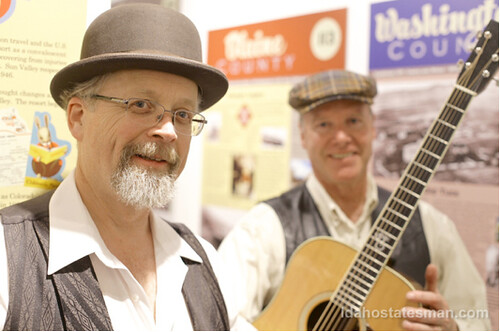
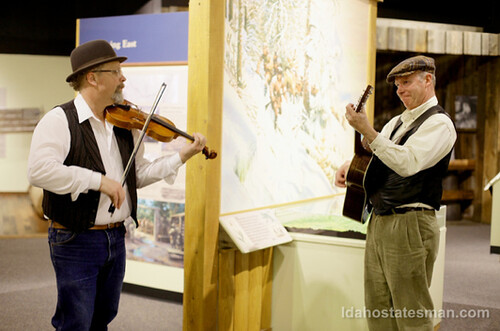
150 years ago yesterday, President Lincoln signed into being the Idaho Territory.  The Idaho Historical Museum put together an exhibit in honor of this, "150 Things that Make the Gem State Unique."  Tim and I were asked to wander about during the Friends of the Museum opening last night, playing a few tunes.  We're always delighted to play at the Museum -- a favorite spot.

Just playing whatever came into our heads, we did manage to get into the Boise paper, the Idaho Statesman --


One of the local TV stations caught us, too.  We're only on film for a brief moment, though our music keeps going.  I'm unaccoustomed to having a TV camera filming me while I play, and spent some energy trying not to make too many weird faces.  Had I known it would be used for background music, I would have relaxed a bit!  :-)  Here's a link to the piece.

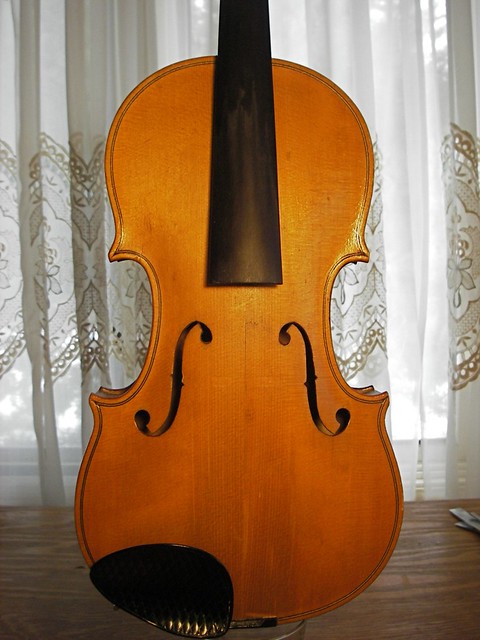
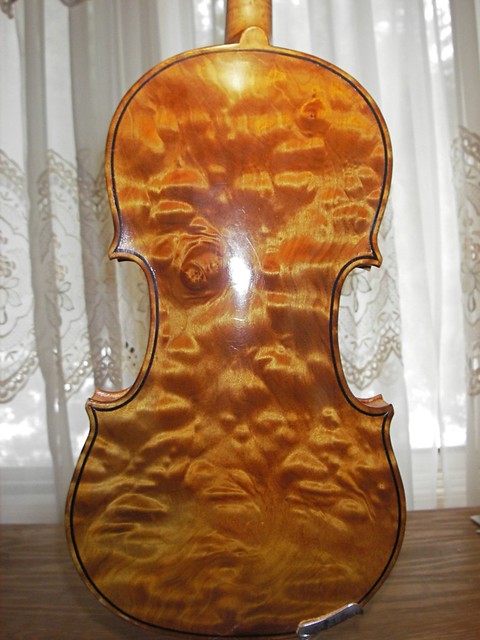
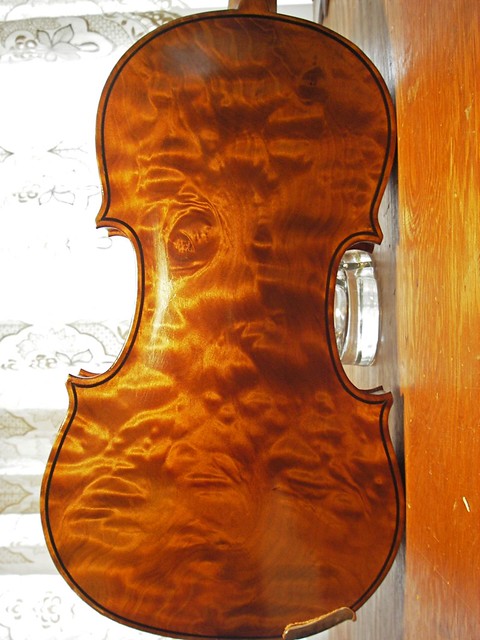
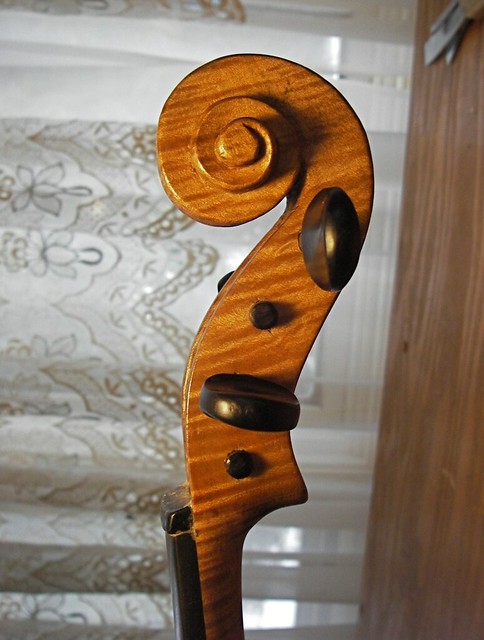
The fiddle here is the one I described building in posts throughout last summer and fall.

Friday, February 8, 2013

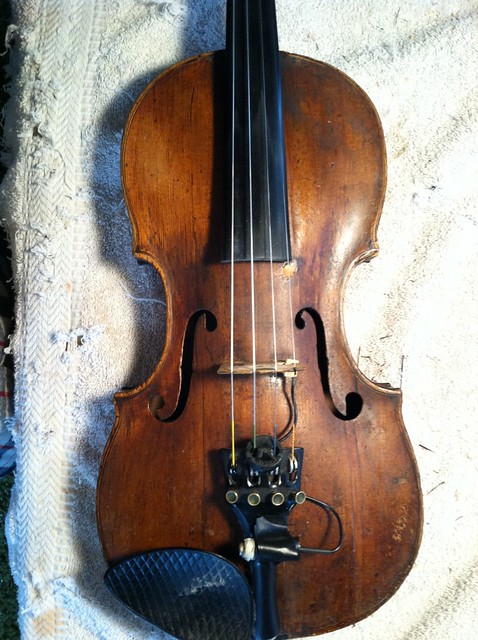
labeled Klotz 1760-ish.

This one is owned by a retired fellow, who has had it for some time.  I don't know if it is what it reports to be, Egidius Klotz 1760 (or so), but it could be.  Glued a seam, new strings, and replaced the old electronic pick-up with a newer model.  He plays it daily.


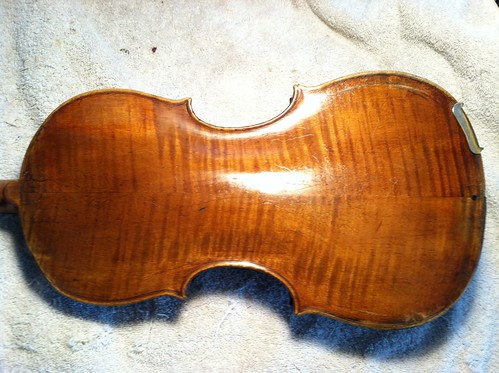
The back has a pleasant flame and shows lots of wear, including relatively recent damage such as shoulder rest abrasions, which are also present on the ribs.


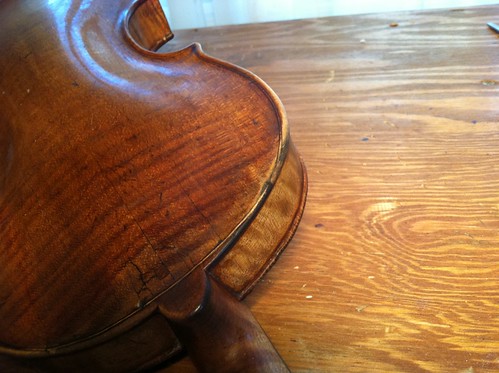
The upper treble bout is so worn that wood is even missing through the purfling itself. Evidence of lots of playing time. The button looks as if it may have been broken, or badly crakced at the least.


Both f-holes are missing wings. This one has had a repair, possibly to correct for soundpost-tool damage. Dunno.


The label is very hard to read.  It seems to follow the pattern: Egidius Klotz in Mittenwald and der Isar 1760.  Could be 1762.  Or 1768.  Or something else. 


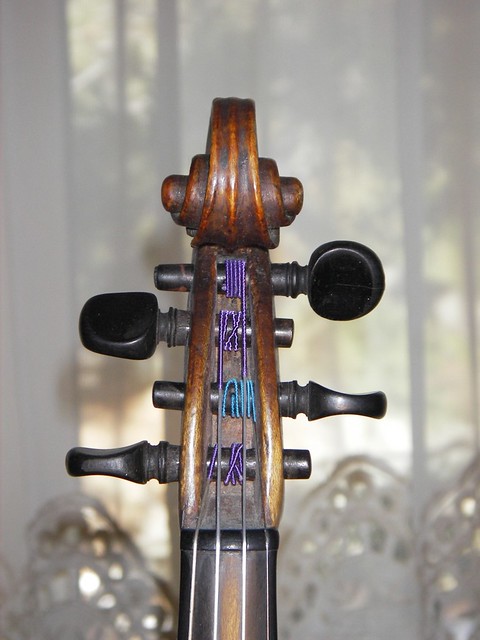
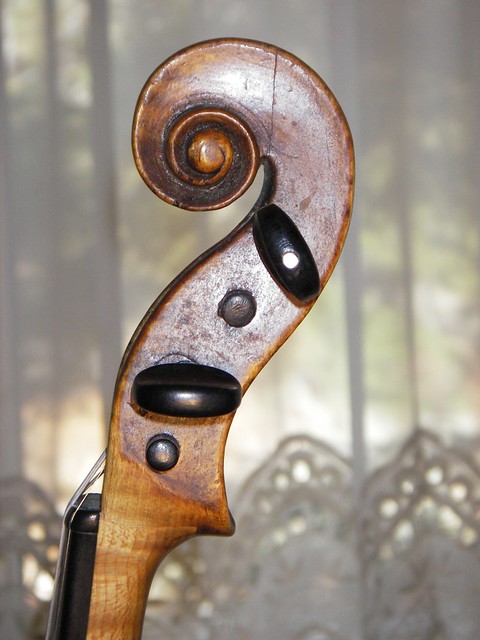
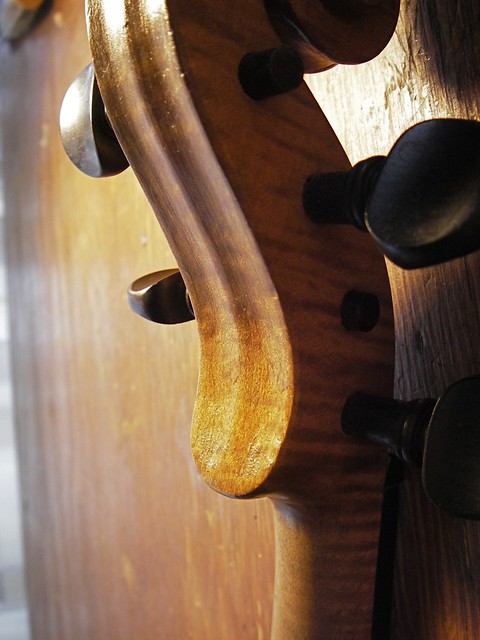
Front of the scroll, showing what I think is a very nice patina.


Apparently the volute became separated from the pegbox at some time.  The pegbox and scroll have been grafted onto a new neck.


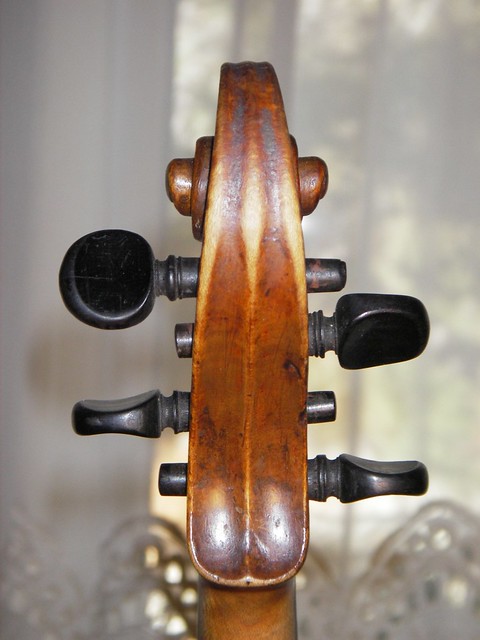
Back of the scroll with a rather square bottom.  Perhaps a compass layout mark where the spine meets the bottom curve.


Tuesday, February 5, 2013

Secrets of the Samurai Sword (PBS)

I recently posted a link (on my Facebook page) to a 4-minute video on Samurai swords, the Sword Maker.  One of my FB violin-maker friends, Jack Havivi of Tel Aviv, gave me the link to a PBS hour-long documentary, now on YouTube, for Secrets of the Samurai Sword.  Both are worth seeing, and naturally the longer PBS version has far more detail.

At one point in the documentary, they refer to "Sword Porn" being the term for the movies most of us in the West have as a basis for knowing anything about the Samurai.

I guess I could diverge and say that many of us seem to get most of our 'knowledge' from movies, but that might be considered cynical, so I won't.

Anyway, in addition to enjoying sword porn, this PBS documentary is also, for us woodworkers, carbon-steel, sharp-edge, traditional-arts, marketing, blacksmith-alchemy, random-effects, waterstone porn.  For me, it hit all of those buttons.

The traditional art of steel-making is also explained in scientific terms, this being PBS, but in doing so, they actually show reverence for the randomness and skill in the process, skill that takes decades to develop.  Even those older folks with the skill are watching and learning, not quite knowing how it will turn out.

I am currently teaching a few math classes at the local community college.  Times being what they are, repair work and sales being down, I took on the classes to keep the cash-flow going.  I'm enjoying it, mostly, and it's actually giving me the freedom to turn down some work on really low-end instruments, allowing me to concentrate a bit more on building.

Although the classes are still a traditional lecture format, the homework is done on-line, with those advantages and disadvantages.  The students work on their problems, they are graded instantly, and if they want to improve their score, they can re-do the problem.  Of course, the 'new' problem is essentially the old problem though generated with different numbers.  And that can cause certain issuess -- sometimes the numbers are not all that 'nice'.

Yesterday, several students were complaining that one problem in particular was 'impossible' to do.  We took a look at it in class and I agreed that it was quite tough, possibly impossible.  Some clamored for more time, an extension on the deadline, and I agreed to give them another day.  After class, I had a few students come up and talk about the problem and how they had got it to work out.  I tried it at home myself later, and it was tough, but doable.

And then I got thinking to my own college days.  I never expected to get all the problems correct.  Most of them correct, of course, because I worked hard until I had some understanding, and I was pleasantly surprised on the rare occasions when I did get 100%.  What's happened to our expectations?

The contrast between that homework situation and the sword-making struck me.  Some of us, myself included, have come to believe that we can always suceed at what we do, that there should be nothing out of our reach, and yet we probably underestimate just how long it takes to get good at something.  Students can believe they should be able to get 100% on all their assignments.  Violin makers can believe that our instruments should be without any clunkiness, that we'll actually like our varnish, or .... pick your favorite mental poison.

Well, actually customers can be quite demanding on these points, too, but that's just the way it is.  You can't take it too seriously.

I found the PBS Samurai video fascinating and inspiring.  Take the time to watch it, even if a bit at a time.  I think you'll find many pleasant surprises.  I'll give away a little teaser.  The shape of the blade is a product of, no, that would be wrong to spoil it.   I was astonished, though, and it was the point that I decided to write this blog post.
Thursday, January 24, 2013

Jim Brown, Violinmaker in Claremont, California.


Jim Brown is the organizer of the Southern California Violin Makers Workshop, which is taught by Michael Darnton.  Jim is the fellow who puts everything together, and is even the fellow who picks us students up as we come in to the airport, one-by-one, scattered throughout the day.

Here's a nice 8-minute video on Jim and his own shop.

Breathing Life.


And one of my photos of Jim giving a varnish demo at the 2008 workshop.


Monday, January 14, 2013

John Craft 1975 violin


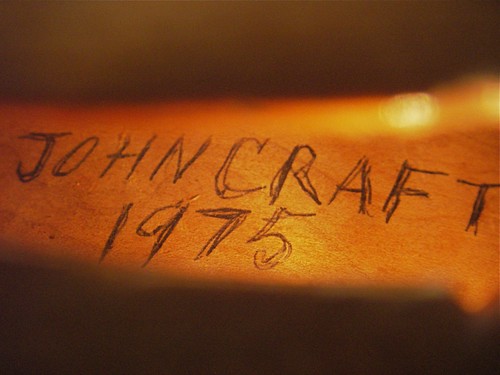
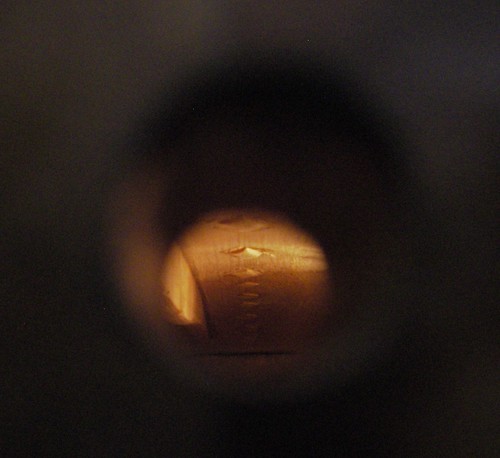
John Craft was a local maker, local being Nampa, Idaho.  This instrument came in for a little repair and set-up work.  Here's his 'label' seen through the f-hole.


In spite of some of their eccentricities, violins made back in out-of-the-way places before much information was readily available interest me.  I never met John Craft, but I do hear stories of him.

The front of the instrument, showing the general outline.  Black-white-black purfling, somewhat pinched corners.


The back was really astounding.  A very dynamic finish, it changed readily with the view angle.  Here are two shots at different light angles.


Note that unlike the front, the purfling is a single black strip.

The pegbox was somewhat oversized, larger and bulkier than normal.  Poorly fit pegs shown here were replaced and the nut was cleaned up.  It was too high and had gobs of glue extending out all sides.  I don't know whether this was the original set-up or if it had been redone at some time.


Curves of the scroll are a bit clunky.  Considering that in 1975 Nampa he probably didn't have much to model it on -- no Internet, no Strad magazine posters -- you do what you do.


The fluting was quite shallow, particularly on the back, with the center ridge nearly disappearing at the heel of the pegbox.


The top seam appeared somewhat open from the outside, though solid.  Looking in through the endpin, we could see many diamond-shaped cleats.


Sunday, January 13, 2013

The Color of Age in Wood, part 2

One of my Flickr contacts commented on my photos, posted in this blog yesterday, mentioning the rust marks in the old 2x4s, something she thought might not be pertinent to violins.  Her argument that (1) a bathroom wall was periodically very humid, and (2) it contained nails -- unlike violins.

Well, it reminded me of a couple things that many violin makers know, but which might not be common knowledge among normal, non-violin-obsessed folk.

First, the violin (and the viola) actually is subjected to fairly humid conditions.  The player is breathing right on top of the instrument, with moist air from the player's nose sending moisture over the top and in the f-holes.  I am an amateur fiddler.  Our band played a contra dance last night, and as the fiddler, I get quite a work-out.  The dance lasts about 2-1/2 hours, and though I'm not playing the entire time, I do probably get a good 45 minutes to an hour of fast playing.

If you watch videos of the really great players, you can often see that they are putting out a lot of energy.  And that's just the performance.  Imagine the thousands of hours that go into practice.

So that's humidity.

Now about nails.  Modern violins are not made with nails.  But in the time of the Amati, Guarneri, and Stradivari, they were.  The necks were not mortised into the neck block as they are now.  They were surface mounted -- a butt joint -- to the ribs, and nailed from behind (drilled first, no doubt) and the plates were installed afterwards.  This method is not as strong, in part due to the differential tensions in the strings.  Necks could be pulled to the e-string side over time or fail altogether.  The neck mortise solved this problem, and nearly all old instruments have had their necks reset, with the addition of wood to make up the difference.

From the National Music Museum at the University of South Dakota, an x-ray of the neck of a tenor viola built by Andrea Guarneri in 1664.


And from a 1693 Stradivari violin, the rust stains from similar nails that have bled out to the surface.


In the Stradivari neck heel, you can also see an extra piece of wood, just above the ebony crown, indicating a neck reset.  That is, that slice of wood was added by a later repair person when working on the instrument.  The ebony crown is a later addition as well, being put in place to clean up damage done to the button in, say, a neck reset.

You can see the rest of the Guarneri viola here and the rest of the Stradivari violin here.

Some violin makers might try to simulate this sort of aging and some players might look for it because it has the 'right' appearance.

Saturday, January 12, 2013

The Color of Age in Wood

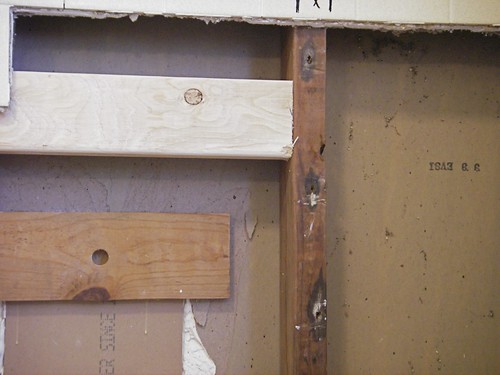
Doing a little bathroom repair, and noticed today something that might apply to violin making, in particular, the antiquing process.  Here we have three pieces of wood, probably similar in color originally.  Probably similar wood, fir of some sort.  Similar to the spruce top of a violin.

The vertical stud is from the 1950s, and most likely has not been exposed to sunlight for much time.  The vertical wood on the lower end is from a repair I did about 10 years ago, from the other side of the wall.  It's backing for a sheetrock repair.  The wood probably had seen some sunlight and was most likely just stuff I had around the shop.  The vertical wood at top is new material, bought at the lumber store the other day.  Photo taken with no flash, sunlight in the window and incandescent in the room.


Same as above, but with the camera flash on.