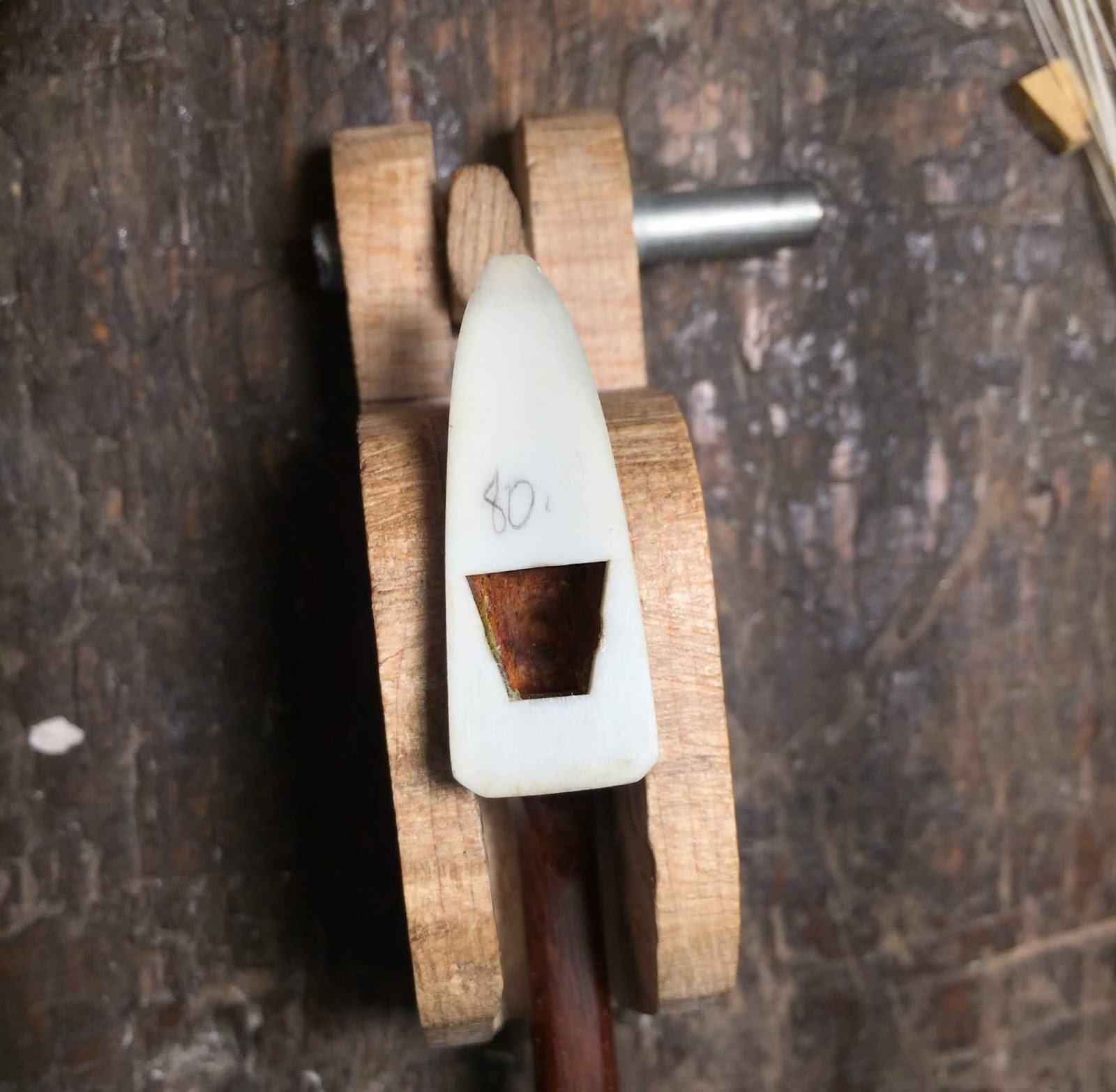
I think I'm about to call it good on the color for this one. Never really happy with my varnish, but at least by changing things every time, I get a spectrum of instrument colors.

And I change the scroll a bit each time as well.


I think I'm about to call it good on the color for this one. Never really happy with my varnish, but at least by changing things every time, I get a spectrum of instrument colors.
And I change the scroll a bit each time as well.
With the cracks glued and cleated as I thought needed, time to fit the new bass bar.
First, layout in pencil. We want the bass bar to be under the foot of the bridge, 'east to west', in a sense as measured from center-line, or from the edge of the f-hole, or some place to hook the tape-measure, as it were. I also don't want it to overlap the upper terminal hole of the f-hole. With these two constraints, there is usually not much choice. We also want it angled relative to the spruce grain, for strength purposes. Lining the bass bar along the grain is a great way to crack the top.
The problem with old tops is that they are not always normal.


The area is so kinky & twisty, in fact, that the original carver decided 'to hell with this' and left it quite thick. 6-1/2 mm, when the normal top thickness here might be around 3.
Cleaning up the top with thumb-planes and scrapers, I discovered an original repair. This little section of wood was pulled out, somehow, during the original carving, then glued back into place, prior to the (original) final graduation of the top. It is open along one side and will need to be re-glued.


There is also a wing-crack to repair and the open crack at the neck, but I don't like to do too many cracks at the same time. I'll get them after this sets.
Another old factory fiddle, well-loved by someone who played it years ago.

Wanting to see it in the hands of someone who would love it again, as well as freeing up closet space, the owner sold it to me. I didn't pay much. A rather plain fiddle, mostly in good shape, but it will take some work before I can feel good selling it.

The fingerboard is not ebony, but hardwood stained to look like ebony. And it is crooked on the neck, overlapping the finger-side. On the thumb-side, the stain is also worn away.


It was a little loose as well, and came off easily. A generous glue channel in the fingerboard and in the neck itself.


For comparison, when I make a new fiddle, I don't make any glue channel. Perhaps the slightest scraper hollowing on the ebony. One could almost fit sympathetic strings in that channel. I'll fit a new, ebony fingerboard to this fiddle.
There was a saddle crack, repaired, and a wing-crack, not repaired. I could also see through the endpin that it had an integral bassbar. So off with the top.

Note the cleats for the repaired saddle crack, on the treble side. And the wildly carved bassbar. One can imagine that took a good 15 minutes to shape.


The top was roughly gouged, though not as rough as many I've seen.

And the top is rather thick.

I might be around 4mm here, if I thought it needed it. But usually less than that. And about 2.5 in the upper and lower bouts.

So, I think I will take some meat out of this top after gouging out the integral bassbar. It will be replaced with a new, standard bass-bar. Both changes will improve the sound.

No corner blocks, not even foolers in the bottom corners. I'll probably leave it that way. Not convinced that blocks would change the sound quality of this particular instrument. And it is a fair amount of work to do so. The corners have held together for sometime as-is.
It's weird that Jacob forgot to add the '42' or whatever after the '16'. That's a joke. Possibly late 1800s, early 1900s. Could be pre-1892, since no country-of-origin on the label, but if so, not by much I'd say.
The back could use some cleaning-up as well. The graduation pattern was 'make it thin but not too thin everywhere'.
So, is this worth working on? I never know. It's something I can do when I'm not doing something else. Maybe keep me out of trouble I might otherwise get into. The fiddle will end up being interesting to someone, some time.