Monday, June 9, 2014

Orchestral Soloist (for a full 30 seconds)


I am now an experienced orchestral soloist!  :-)

Being a fiddle player who has always enjoyed classical music, I long ago thought that once the kids were grown and out of the house, I'd maybe find a community orchestra to join. See what it's like.  As the kids and I got older, I realized that I probably just couldn't cut it in an orchestra -- all that bowing the same way, not haphazard like I do, for example.

It turned out, though, that last January, a few months after my youngest left home, the new director for the Serenata Chamber Orchestra, Jen Drake, invited me to participate.  I couldn't let it pass.

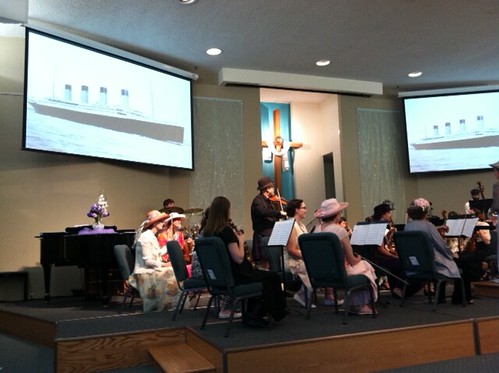
This is my second concert with them, and it was a "Downton Abbey" themed event.  One of the pieces was a couple tunes from the movie "The Titanic" (because in one of the early episodes of Downton Abbey, the Titanic sunk).  And Jen asked me to play a fiddle break between the two orchestrated fiddle tunes in the piece.  I played "The Rose in the Heather" -- all 32 bars, or effectively about 30 seconds.  Really different for me, trying to figure out how to fit it in, and I'm not sure I did it the best way, but people had fun.

My wife managed to snap this photo during my solo.


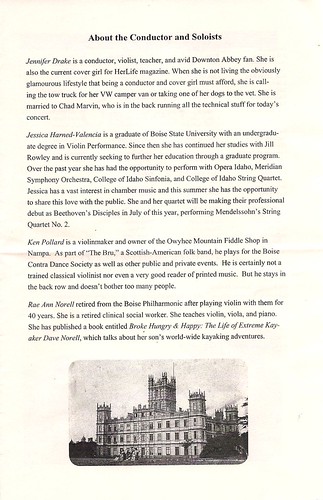
From the concert's program, a bio-page of the soloists, including yours truly.


Thursday, June 5, 2014

New and old, progress at least.

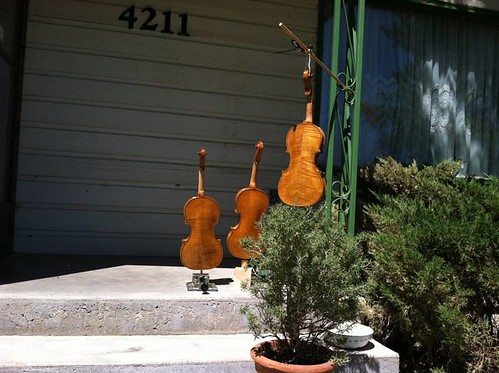
With the semester of college teaching over, and Weiser on the near horizon, I'm actually getting a few things done.  These 3 are essentially cured, and next to polish up the varnish a bit, then fit them up.


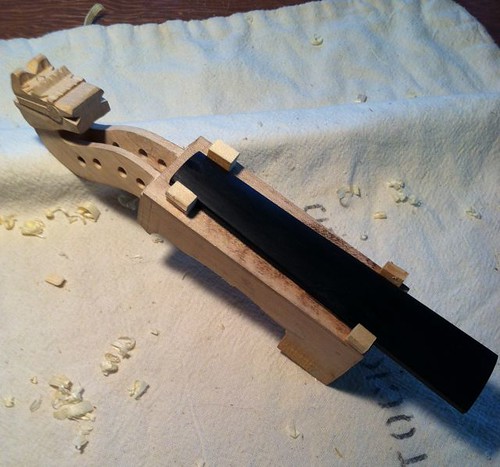
A stubby little fingerboard for a pochette.


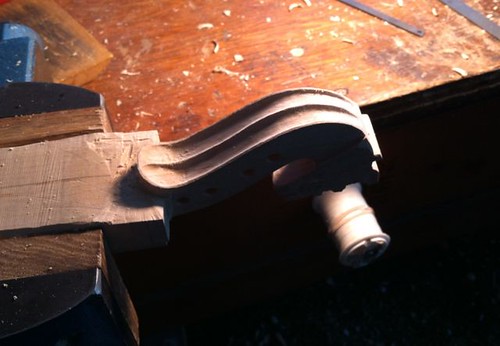
Suddenly realized I hadn't fluted the back of the pochette scroll, so quickly dug in.  Forgot to chamfer the sides first, so the outside edge will be lower than the center.  Not my plan, but a common feature.


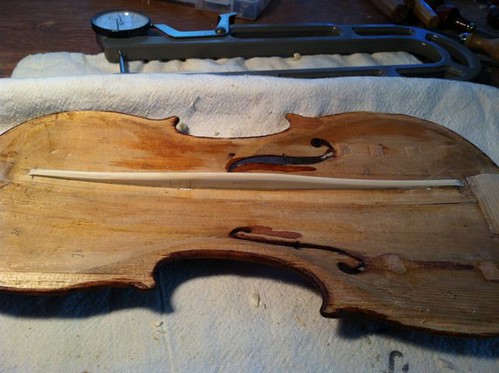
New bassbar in one of the old fiddles I'm fixing up for Weiser.


This is a customer instrument, typical of many student instruments of the late 1800s, early 1900s.  Integral bassbar, false corner blocks (lower), Strad label, hair ball, horse hair, and strings ends floating around inside.  Unusual round cleats holding the center seam.  Some of these old horses work fine.


Wednesday, June 4, 2014

Bench Hook.


Earlier this year, I read a blog-post that made think -- "That is a marvelous idea. Why have I not thought of this or even heard about it before?"
Here is the link to that blog-post .
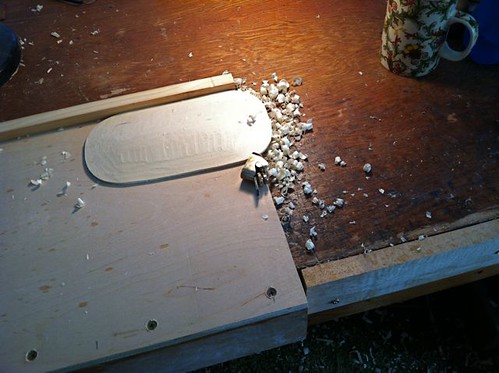
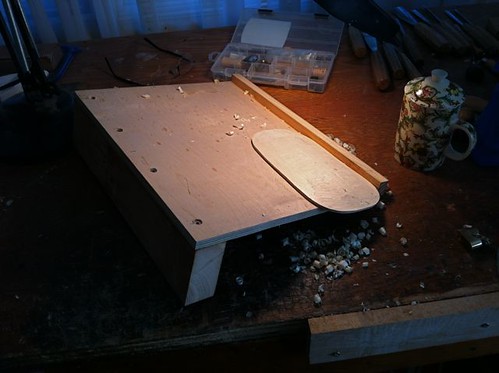
Finally with a little time to get something done, I threw one together with scrap I had around the shop. I made the main holding area wider than in the original post, because I want to use it for violin plates.

It's great.
I don't know that I have the optimal size -- this is literally from scarp around the shop. I had a piece of plywood that size next to the bench. I used a section of old 2x4 for the part that hooks over the bench, and a small piece of pine for the stop at the far end.
Here is the bench hook unhooked.  Try it; you'll like it.

On the another front, I have a couple fiddles with their final coat of varnish on.  My latest (left) and an earlier one which I have stripped and revarnished.  Out catching some morning sun.


Monday, May 19, 2014

SpringAlive 2014 workshop, part 1


We traveled last weekend up to La Grande, Oregon, for the SpringAlive 2014 workshop.  We've been several times in the past, and in the recent years have just really learned a lot from this event.  It is a contradance workshop, covering both dance and music.  I was involved in both parts -- fiddling and dancing -- so really didn't get any photos from the event itself.  Others did, and I will write more on the workshop itself soon, hopefully also including a few photos.

But I thought I'd add here a few photos of the trip up.  Monica drove, so I  had the luxury of just watching the scenery, scenery I've seen so many times, so familiar to me, and yet seldom with the opportunity to actually look at it.

I decided to take a few photos with my phone. Not great quality, but maybe of some interest.

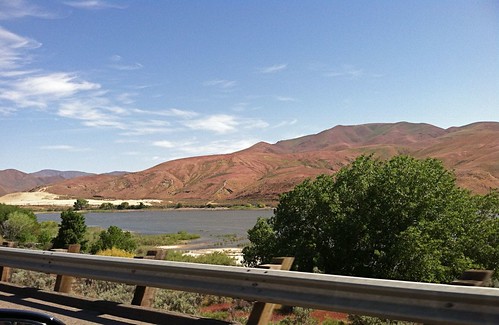
The first one here is at La Grande, Oregon, just across the border at the Snake River.  I drive this way when going up to Weiser for the National Old-time Fiddlers Contest, and there is a little stretch of tributary river, right next to the freeway, which is so nicely wooded and tranquil that I always like seeing it.  Unfortunately, the viewpoint is at the top of a freeway bridge with no place to stop.  I tried to get 'the' shot, but failed.  I did get a decent one of the nearby railroad bridge.


As a side-note, for those who eat such stuff, many of the country's Tater Tots are made at the little factory on the reverse side of the freeway.  It's not so scenic, although it is fairly easy to spot a little steam 'smoke ring' coming out of one of the stacks.

Farewell Bend is the place where, in the old days, The Oregon Trail left the Snake River after following it for a few hundred miles.  Following the Snake River downstream takes you through Hells Canyon, which, as the name suggests, isn't exactly wagon country.  Nor freeway.  It follows the Oregon Trail crossland here.

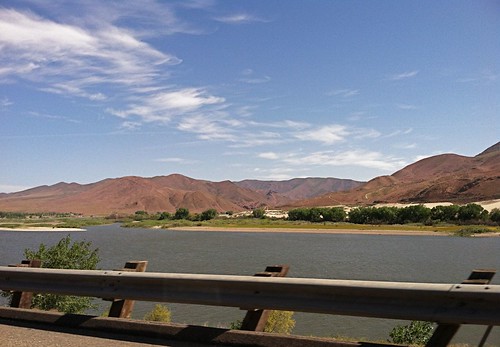
This shot is looking downstream towards Farewell Bend, though it's just out of sight on the left.  Idaho is across the river.


And here's a shot that catches Farewell Bend on the right, and the entrance to Hells Canyon as the Snake veers downsteam towards the right of center.


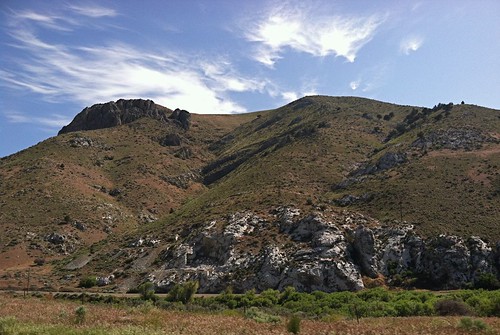
As the Oregon Trail (aka I-84) continues cross country, we follow the Burnt River.  This time of year, things are fairly green.  When the Oregon pioneers came through, it would have been late summer, and fairly dry.


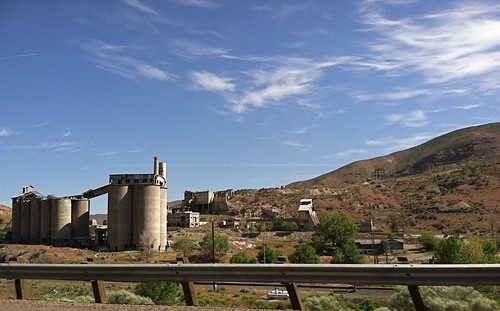
At the conveniently named Lime, Oregon, is an abandoned cement plant.


It's fairly interesting to look at, to my mind.


Between Baker City and Ontario, we pass a landmark that reminds us to be on good behavior because it's easier for Santa to see us now.


It's hard to tell in the photos here, but the Arrowleaf Balsamroot were in bloom.  Yellow flowers, smell of vanilla.


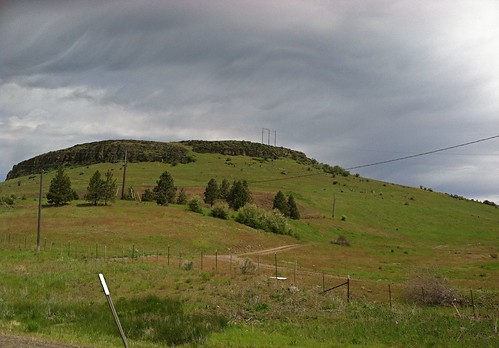
Ladd Canyon is a relatively steep but short canyon the descends down to La Grande.  In the winter time, it can be quite treacherous, and is sometimes closed.  I spent a few days in La Grande one December, stuck between the closed freeway in Ladd Canyon on one side, the Blue Mountains on the other.

Here we are just about to descend into the Canyon.


So then we got to La Grande, secured our hotel room, and headed off to the workshop.  A musicians workshop taught by Susan Songer  and Lanny Martin of Portland, a dance workshop taught by David Kaynor of Massachusetts.  Lots of good info.  A potluck dinner, then the dance, where all the musicians got to play in the band.

Sunday morning I had an hour-long private fiddle lesson with David Kaynor.  As I mentioned, I write more about the event itself in a following blog post.  I will mention that it is a worthwhile event.

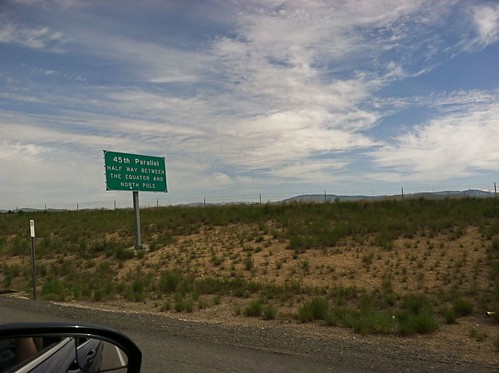
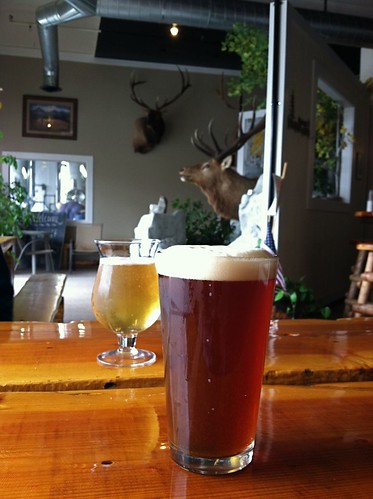
We headed on home, and once safely on the other side of the 45th Parallel, out of Santa's view, we had a beer with lunch at the Bull Ridge Brewery in Baker City, Oregon.


The "Bull" of Bull Ridge being bull elk.  Lone Pine Lager in the rear, Sugarloaf IPA in the foreground.

Monday, May 5, 2014

2014 NW Handmade Musical Instrument Exhibit

We got off for a quick weekend to the Portland area to see the goings on at the Northwest Handmade Musical Instrument Exhibit.  It was a worthwhile trip.

The Exhibit is set-up in a Marylhurst University building in Lake Oswego, Oregon (just south of Portland).

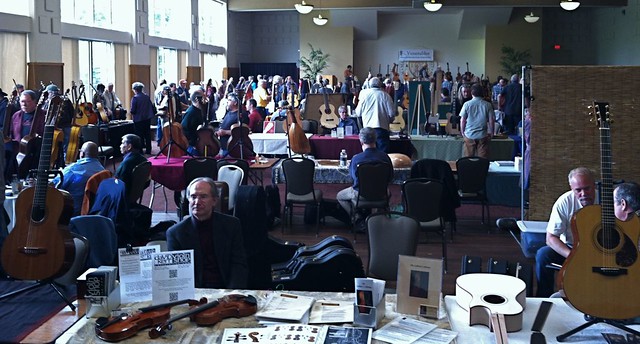
The place was hopping with exhibitors and folks interested in seeing new and different instruments.  Lots of talking, lots of playing.

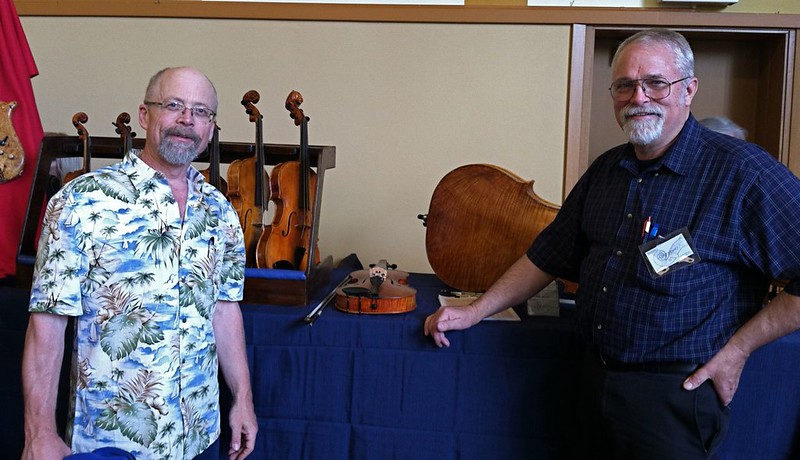
One of the makers I wanted to meet in person was Chet Bishop.


Myself (left) and Chet Bishop (right). Chet and I have 'spoken' to each other via e-mail and forums for years, but have never met in person before. I got to play all his violins and violas here, and nicely done they were. We had a good discussion of arching and wood types, and a general whining about varnish woes.


Being mostly interested in violins, I spent most of my time talking to the 10% of the exhibitors who were violinmakers.


I took a week-long violin set-up course from Paul Schuback in 2007 at the College of the Redwoods (Eureka, California).  We had a nice chat, and he gave a very useful critique of one of my violins.  It's that sort of information that is so useful to makers, and one of the things that makes these sort of events so useful.


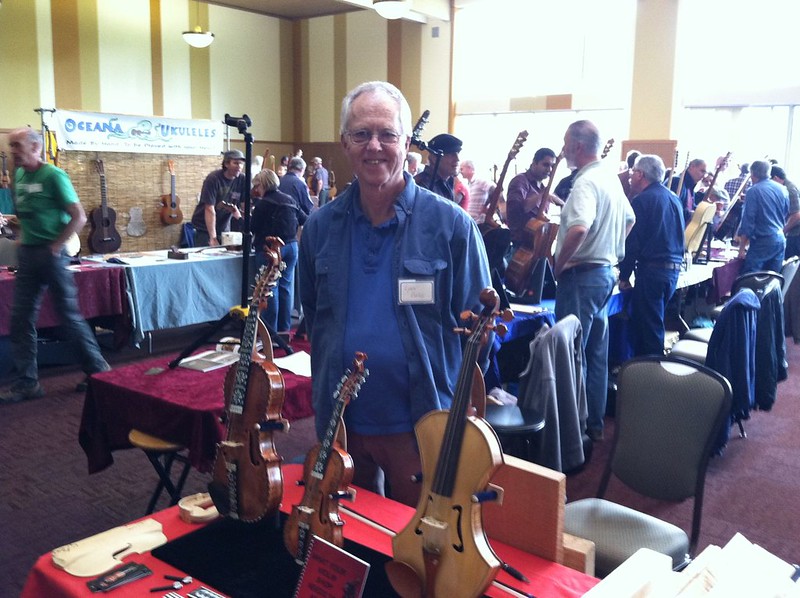
Lynn Berg, Eugene, Oregon, and some of his Hardangar fiddles.  I had one of his Hardangars in my shop some years ago, a very interesting and intricate instrument.  I like the sound.  We spoke for a few minutes about the building of Hardangars.  He seems busy building these instruments.
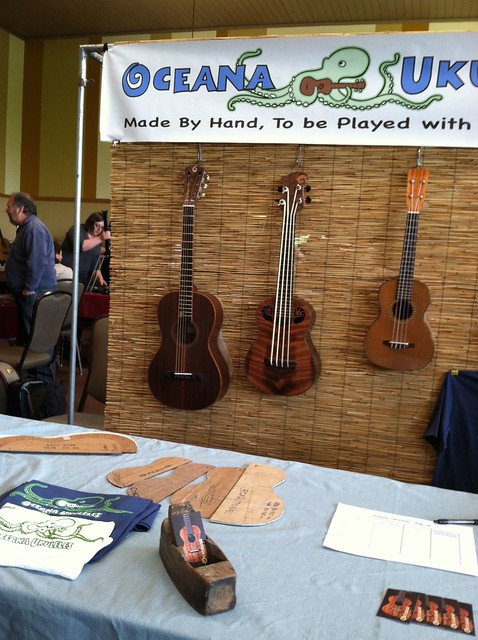
And, some of you may have notice in the background -- ukuleles!


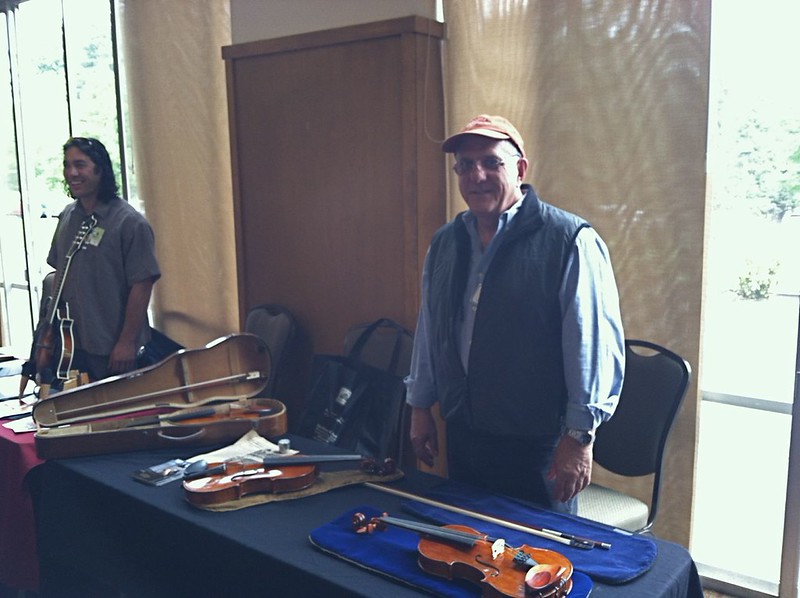
Near Chet Bishop's display was Kerr Violins (Portland).  I spoke with Mr. Overstreet (?) here (I'm terrible with names and forgot to write it down).   


Andy Emert, who also works at Kerr, was elsewhere this day.  Andy is a champion fiddler and is always stops in at our shop during the Weiser contest.

A few other scenes from the event as I saw it.


For more photos, taken by Chet Bishop, before the doors were open, you can go to his Fiddle Hangout post.


Friday, October 25, 2013

Soundposts and craftsmanship


Cheap fiddles have been sold as long as fiddles have been sold.  The customers are the poor or uneducated.  It looks like a violin.  I want to see if I like it before I spend much.  The usual story we've all repeated when trying to save some money on something.

One came into the shop the other day.  "Doesn't sound so good," was the complaint.  Actually, "sounds really bad" was the complaint.  The e-string was unbearable.  Starting off with bad equipment is an easy way to answer the question "will I like it?", but that's part of the education angle.

Here's what the soundpost looked like.


This was how it was sold by a music store in the area -- a starter fiddle -- and at least implied that it was a product ready-to-go.  It was not.  Note the minor contact of the soundpost with the back.  Not only will this prove less than optimal in tone, it is also dangerous for the instrument.  Over time, this can create a crack in the back.  Once a back-crack occurs on an instrument like this, it's all over.  Out it goes with last week's garbage.

This factory-installed soundpost had badly cut bevels -- I actually doubt much thought was given to them at all -- and the post overall was too short.

We put a new one in.


We replaced the strings as well, the factory strings being only decorative.  I probably shouldn't use the word 'decorative' that way.

It sounds much better now.  Never going to be great, but at least it is essentially firing on all cylinders  The owner might actually grow to like playing the fiddle.


Wednesday, September 18, 2013

Student cello repair

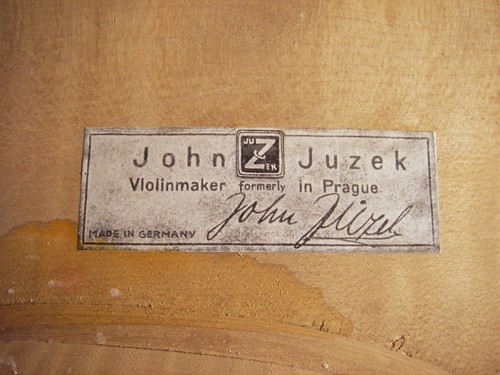
This time of year, I see instruments from the local schools that need repair.  This is a cello from a middle school.  It's been around for years.  The label is a photocopy of a Juzek label, and I never know what to think of these.  They are common, and I don't know if the Juzek factory did this, or if it's a knock-off.  It's not a bad little cello, but it's seen a lot of abuse from middle-school students, which, of course, is one way these students learn.


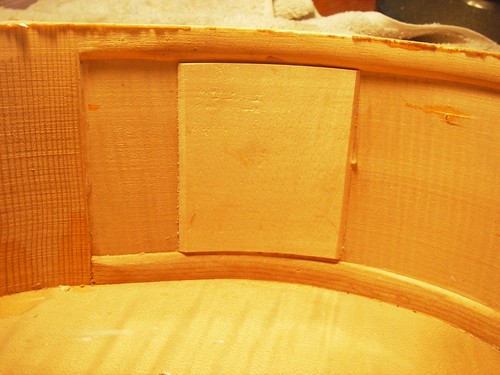
This cello has had many repairs, including having the top off.  This is a fitted patch for a rib crack.  Reasonable, if a little thick.  I left well-enough alone.


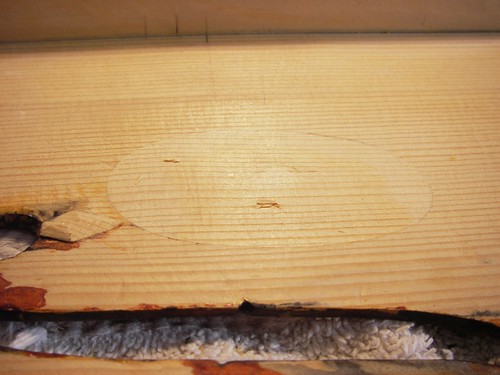
Here is a soundpost patch, nicely done, though with some later damage due to improper soundpost position, and a diamond-shaped cleat to help hold the crack.  I suspect the diamond cleat was added without taking the top off, with a clamp through the f-hole, and whoever did it didn't realize there was already a soundpost patch in place.


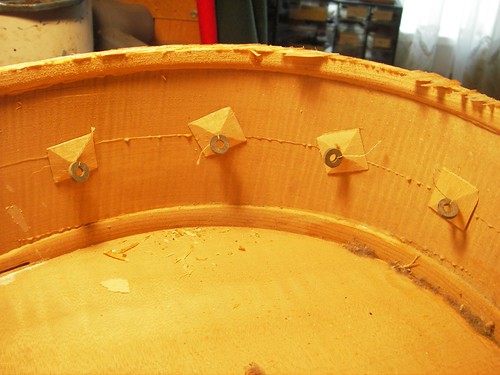
Here are pyramidal cleats put in on a rib crack, done through the outside.  The little 'doughnuts' actually serve to hold a thread.  In this method of repair, a hole is drilled through the ribs for each cleat, a wire or thread run through the hole and wiggled out the f-hole, the cleat is then run through it, with the ring to hold it tight.  Glue applied to the rib-side surface, it is then pulled back into place against the rib and tied into place until the glue dries.  Not recommended.  All of these cleats were loose.  I removed them and recleated with linen.


So, is this cello worth this amount of repair?  Probably not, but I am not charging full rate.  I hope it is some contribution to the orchestra program in my area, and that some student will perhaps learn to love playing the cello.  At the very least, we will get a few more years out of this little (3/4) cello, and it is actually far nicer than many of the newer 3/4 cellos I've seen in recent years.  Many of those are complete junk.