Monday, January 23, 2012

Contempt for their product.

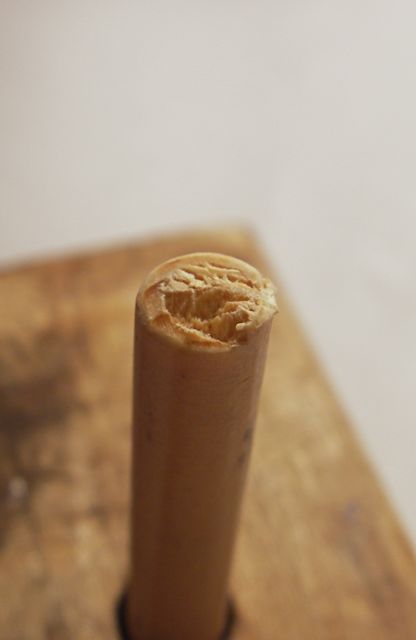
Another in the soundpost series -- an example of why it's not a good idea to simply give a quote for standing a soundpost. This one came out of a violin-shaped object. I had quoted them the price for a new soundpost, because I guessed that I wouldn't want to use what was bouncing around inside. There's something about the way this one was cut symbolizes the contempt with which many of these cheap Chinese vso's are made. Not even an effort at cutting a bevel. One should see smooth bevels that match the inner surface (top and bottom) of the the instrument. This one was simply crimped off, partially, then broken off the rest of the way.


But, hey, they're affordable!


Thursday, January 19, 2012

Quickly hewed pegbox

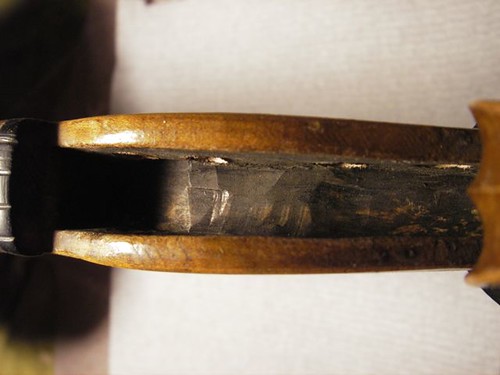
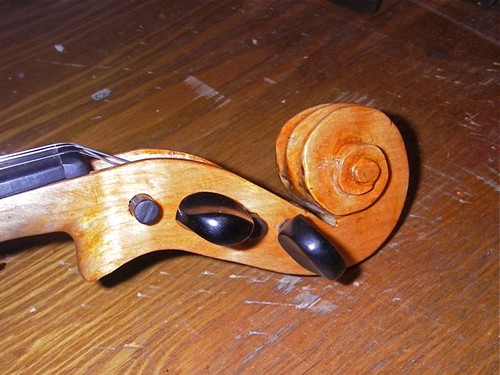
In the shop today, I was setting-up a ca. 1900 factory fiddle, with the usual integral bass-bar and no corner blocks, for a customer. While fitting pegs, I noticed this one had quite a rough gouged bottom to its pegbox as well.


Here's a closer view, at slightly different lighting.


Thought it was an interesting comparison to a more recent factory fiddle with its milled pegbox. Quick work with a gouge vs. quick work with a milling machine.


The blog post on this milled pegbox is here.

Tuesday, January 10, 2012

Alternate methods of fitting a soundpost.

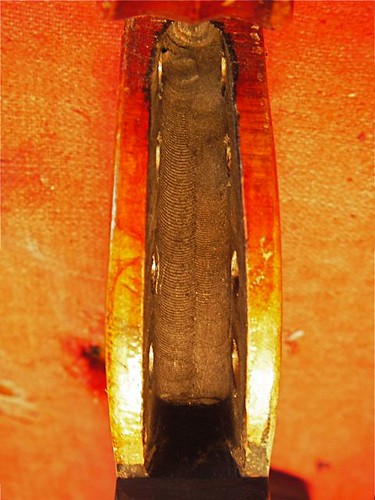
Consider, if you will, this soundpost removed from a customer's violin. The method of fitting: chew off the end of a stick, build it up with putty, then sand to the appropriate bevel. When inserting in the violin, add a dab of hide glue to the ends.

These are just some of the things they won't teach you in violin-repair courses.


Flashed view of the putty-end soundpost, to show a different contrast.

As interesting as this one was, I replaced it with a more traditional soundpost, one without putty or glue on the ends.

Sunday, January 8, 2012

Cheesy Pop Song


Well, I have to brag a little. My son, Roger, had a tune accepted by Rock Band. It's been selling copies, and just got a nice write-up in the Rock Band Network Highlights.

His tune can be seen in his original video, Cheesy Pop Song, on YouTube.

Pretty cool.


Monday, December 26, 2011

Handmade amateur fiddles

Just the other day, a fellow violin maker and Southern California Violin-makers Workshop attendee, Anya, posted on her blog a photo of an instrument in her shop for repair. The post is here.

On the same day, I got a customer fiddle that is a relative, in spirit, of the one in Anya's shop.


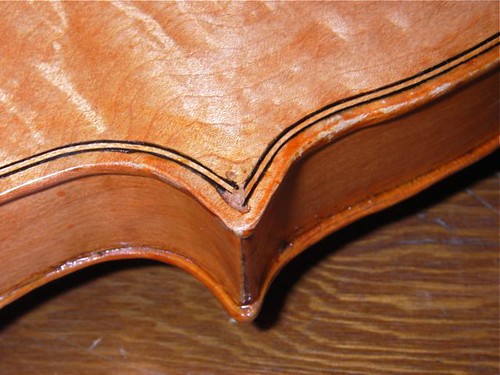
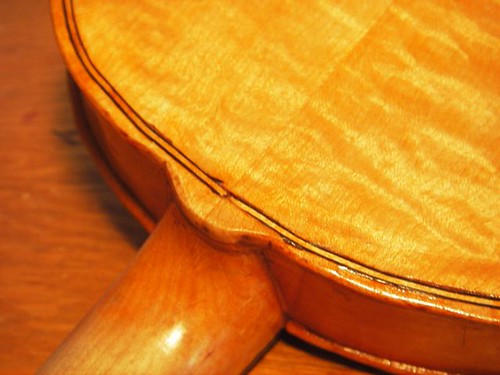
This fiddle was built recently, in the 21st-century, and was built by the grandfather or uncle of the player. It is a treasured fiddle for that family, means a lot to them, and has at the very least the grace not to be another $100 violin-shaped-object (VSO) from some factory in China - even though the VSO might have more conventional design.

It's part of the fun in this business, seeing these one-off instruments that don't pretend to be anything besides an amateur's effort.


Thursday, December 15, 2011

Fifteen years, give or take.

I had a customer in the shop yesterday who was renting a 3/4 violin for her son, and wanted to trade up to full-size, the kid having grown some in the meantime. It happens, and that's one reason folks rent violins for their kids. The youngster had taken good care of his 3/4 and we just swapped up to full-size. No problem.

This mother had taken lessons from me several years ago, even bought a fiddle from me. She wanted me to check it over, see that everything was still in working condition. Again, happy to do so, and she pulled it out of the case.

It was a fiddle I had purchased at an estate auction, at a farm in Meridian, Idaho, that is now the location of the Meridian Library. No longer farm country, Meridian having grown some in the meantime.

It was a ca. 1900 German trade fiddle, really nice tight stripe on the back. As it came to me, it had mechanical pegs, similar to guitar tuners. I removed those, filled in some of the screw holes with maple, bushed the pegholes and fit new ebony pegs. There was a crack in the top, so I removed the top to find a fairly awful graduation of the top -- gouge marks and an integral bass-bar. So I cleaned that up, too, and put in a real bass-bar. That was the first bassbar I had fit, and I'm guessing it was more than 15 years ago, give or take. Didn't take any photos, as it wasn't really the opportunity to do so, and I didn't think of it.

The fiddle was in fine shape. Pegs still worked. Bridge still in good shape. Bassbar hadn't fallen off. Really, no reason for it to, but still, it was nice to see the fiddle these years later, still in working condition.

That being said, I am finding that my 6-year-old computer is nearly obsolete. Many internet programs (such as newer youtube videos) won't run on it any longer -- a Mac with a powerPC processor. Seems just as I get used to a computer, I need to replace it. Thankful that fiddles aren't the same way.

Sunday, December 11, 2011

The Nickel Shim

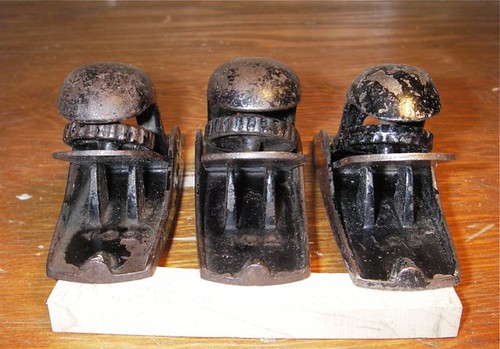
I've picked up a few Stanley 102 planes recently. They're light in weight, simple in design, and inexpensive in price. These are not so pretty, but I don't care. They work.


If you get them on e-Bay, which is what I did (one at a time), they generally require some clean-up. Dirt, rust, grime are some of the issues. The adjuster is a simple screw mechanism, and on one of these, the middle one, it was so worn that it would not hold the blade tight.


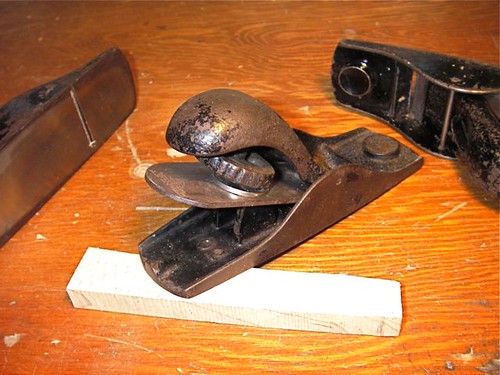
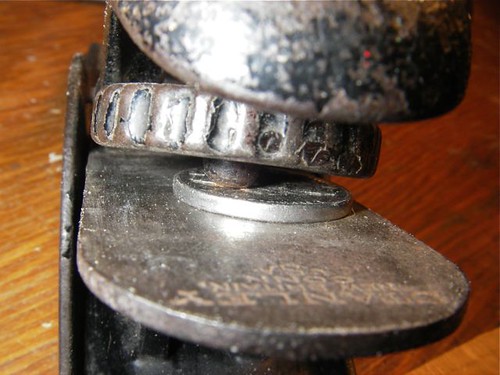
I decided that a shim might do the trick, get the adjuster screw a little higher and onto firmer threads. The nickel shim works just right.


Here's a closer view of the nickel shim. Ironically, the more expensive shim, twice as expensive, in fact (though shinier) didn't work as well. It was too thin. I think you will agree that the craftsmanship of the shim is impeccable.